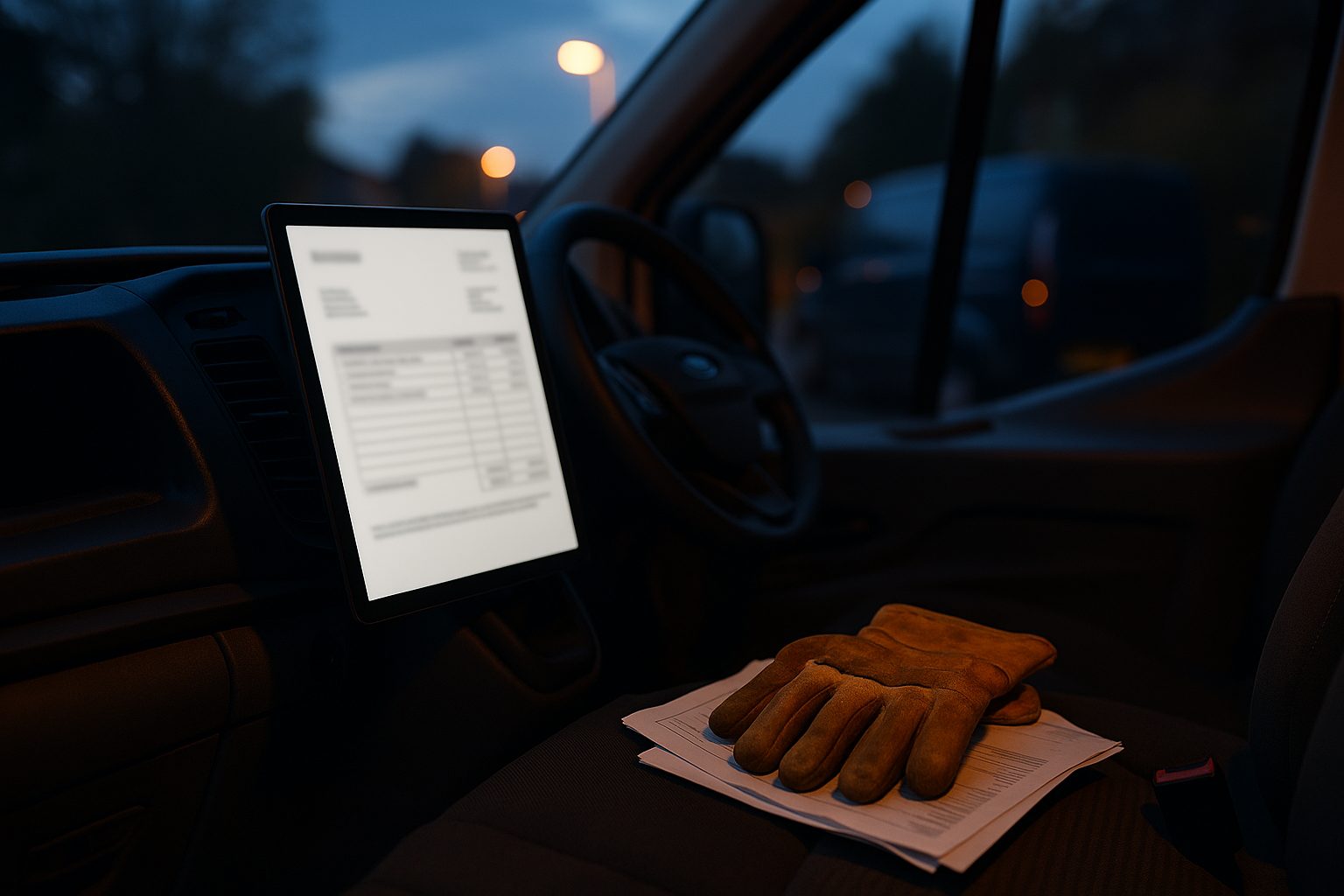
The work is the easy part. Any decent roadside team can attend a breakdown, fix it and move on. The bit that quietly drains the business is what happens next: turning a hundred completed jobs into a hundred correct invoices, sent promptly to the right work providers, with the proof attached. Get that wrong and you are doing the work for free longer than you should. Here is how to close the gap between job done and invoice sent.
Why breakdown invoicing is harder than it looks
Invoicing a breakdown is not like invoicing a single tidy job. You are often billing different networks and fleets with different rates, different reference requirements and different expectations of what evidence they need to see. Multiply that by the volume of a busy month and you get the classic trap: a pile of jobs waiting to be billed, each needing details dug out of a job sheet, a chat message or someone's memory before an invoice can even be started.
That reconstruction is where the money leaks. It is slow, it is error-prone, and every job you cannot fully piece together is a job you under-bill or do not bill at all. The longer the gap between doing the work and raising the invoice, the colder the trail and the worse the leak.
The costs of the slow route
- Cash flow lag. An invoice sent three weeks late is paid three weeks late. Your money sits in someone else's account earning them, not you.
- Under-billing. Details reconstructed from memory miss lines — the extra part, the second hour, the wait time — and those missed lines never come back.
- Disputes. An invoice without clear proof of attendance invites the network to query it, and every query delays payment further.
- Admin drag. A day of month-end invoicing is a day not spent taking work or running the operation.
The one-step principle
The fix is to stop treating invoicing as a separate job that happens later, and start treating it as the natural last step of the case you already logged. If every callout is recorded properly — the vehicle, the work, the time on scene, the parts — then the invoice is not built from scratch. It is generated from the case. You are not retyping anything; you are confirming what is already there and pressing send.
That is the heart of it: the job record is the invoice, minus the formatting. When the two are joined up, "job done to invoice sent" collapses from a three-week reconstruction into a single step at closure. The invoicing add-on in Callout360 works exactly this way — it takes the completed case, builds a proper VAT invoice with per-line VAT, produces a clean PDF and emails it to the work provider, all from the details you captured when the job came in and while it was worked.
What good looks like
- No rekeying. The case flows into the invoice. If you logged it once, you never type it again.
- Per-line VAT and a clean PDF. The invoice looks professional and adds up correctly, because the software does the sums.
- Proof attached to the job. The arrival times and photos that live with the case are your defence against disputes, ready before anyone asks.
- Sent same day. Because the invoice is generated at closure, it can go out while the job is fresh, not weeks later.
The real win is getting paid faster
Speeding up invoicing is not really about saving admin time, although it does. It is about the calendar. An invoice raised the day the job is done starts its payment clock weeks earlier than one raised at month end, and it carries its own proof so it is less likely to be queried. For a small operation, pulling that whole cycle forward is the difference between chasing cash and having it.
Callout360 is built so that for roadside repair agents, the invoice is the last click of the case, not a separate month-end ordeal. Do the work, close the job, send the invoice. One step, while it is still warm.