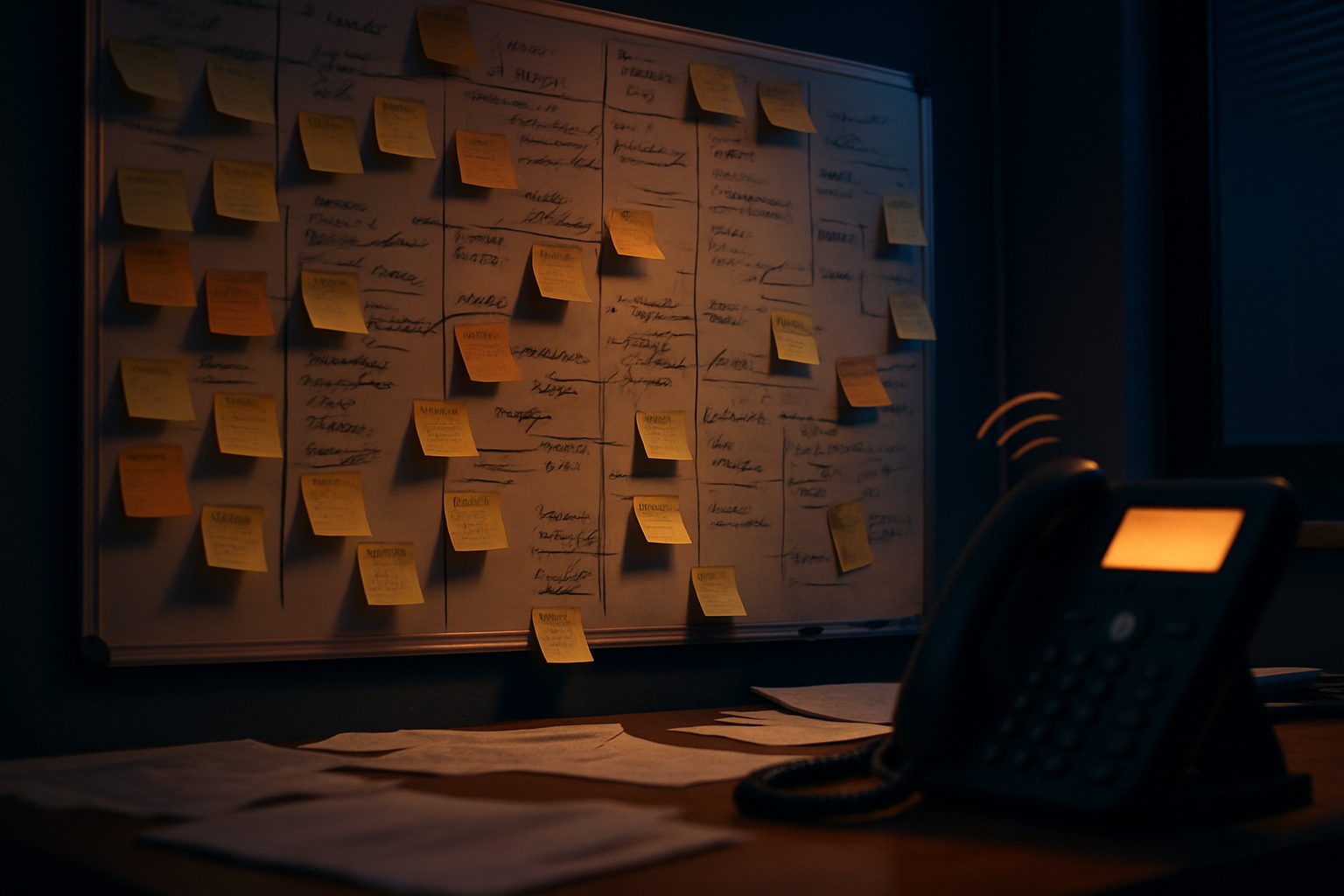
Almost every breakdown operation starts the same way: a whiteboard on the office wall and a WhatsApp group for the engineers. It works. For a while it works brilliantly — it is fast, everyone can see it, and it costs nothing. Then the volume creeps up, and one busy week you realise the whiteboard has quietly become the thing holding you back. This is why.
The whiteboard only exists in one place
A whiteboard is a single copy of the truth, stuck to a wall. That is fine when one person stands in front of it all day. It falls apart the moment two people need it at once, or the controller who owns it goes home, or someone wipes a line to make room and loses a job that had not been billed yet. There is no history — once a case is rubbed off, the proof it ever happened goes with it. And if a network rings to query a job from last Tuesday, the board cannot help you, because last Tuesday was wiped on Wednesday.
WhatsApp scatters the job across a dozen chats
The group chat is worse than it looks, because the details of a single callout end up spread across a running feed mixed in with every other job. The address is in one message, the fault in another, a photo three screens up, the engineer's "on scene" buried under banter. To reconstruct one case you scroll and squint. Nothing is structured, nothing is searchable, and nothing is linked to an invoice. When you need to prove attendance or bill accurately, you are archaeology-digging through a chat log.
It also has no idea what an SLA is. WhatsApp will not tell you that a job logged forty minutes ago still has not been accepted by an engineer. It just sits there, calm, while the clock you are actually being judged on runs down.
Where it breaks, specifically
- Simultaneous cases. Three calls in twenty minutes and the board becomes a scramble. Something gets written in the wrong column, or not written at all.
- Handover. The night controller knows things the day controller does not, because half of it lived in their head and the other half in a chat they have now scrolled past.
- Proof. A network disputes a job and you cannot quickly show the arrival time, because it was a verbal "yeah I'm here" in the group.
- Billing. At month end you are rebuilding jobs from memory and messages, and you know for a fact some work is going unbilled.
- Growth. You turn down work not because you lack engineers, but because you cannot see clearly enough to take on more.
What actually fixes it
The fix is not more discipline or a bigger whiteboard. It is moving to a shared record where every case is one structured thing that everyone can see at once, updates live, and never gets wiped. Dispatch stops being a shout across the office and a group message, and becomes an assignment that notifies the engineer directly by email and SMS. The board in your head becomes a live dashboard anyone on shift can read, so handover is a glance rather than a briefing.
Crucially, because every case is a permanent record with times, notes and photos attached, the proof problem and the billing problem solve themselves — the evidence is already there when the network queries a job or when it is time to invoice. This is precisely the jump Callout360 is built to make for roadside repair agents: keep the speed and visibility that made the whiteboard great, lose the single point of failure that makes it break.
None of this means the whiteboard was wrong. It got you here. But the same simplicity that made it work at three jobs a day is what makes it dangerous at thirty. The tell-tale sign that you have outgrown it is not a dramatic failure — it is the low background hum of nearly-missed jobs, disputed attendances and unbilled work that you have started to accept as normal. It does not have to be.